The Promise of Deep Networks
In Level 2, you learned about neural networks. But here's the exciting part: the more layers you add, the more powerful the network becomes! At least, that's what everyone thought...
Imagine trying to recognize a cat:
This hierarchical learning seems perfect. So researchers kept adding layers: 10, 20, 50, 100... But something went terribly wrong.
Hierarchical Feature Learning
Deep neural networks exhibit a remarkable property: hierarchical feature extraction. Lower layers learn low-level features, while deeper layers compose these into higher-level abstractions.
Feature Hierarchy in Vision
- Layers 1-2: Edge detectors (Gabor-like filters)
- Layers 3-4: Texture detectors, simple patterns
- Layers 5-6: Object parts (eyes, wheels, corners)
- Layers 7+: Complete objects, semantic concepts
This compositional structure suggests that deeper networks—with more layers—should achieve better performance by learning increasingly abstract representations.
The Depth Hypothesis
Prior to 2015, the prevailing wisdom was: deeper is better. Theoretically, a deep network can represent any function a shallow network can, with exponentially fewer parameters (Eldan & Shamir, 2016).
However, practical training of deep networks encountered a fundamental obstacle.
The Problem: Vanishing Gradients
Remember backpropagation from Level 2? Gradients flow backward through the network, telling each layer how to adjust its weights. But in deep networks, something terrible happens:
Why does this happen? It comes down to the chain rule. Remember, we multiply gradients together as we go backward through the network. When you multiply many small numbers together, they get really small:
📉 Gradient Flow in a Deep Network
Watch how gradients shrink as we go backward through layers:
Result: Early layers learn almost nothing. The network effectively becomes shallow, wasting all those extra layers!
Gradient Vanishing in Deep Networks
The vanishing gradient problem arises from the nature of backpropagation in deep architectures. Recall that gradients are computed via the chain rule:
For a network with L layers, the gradient involves multiplying L Jacobian matrices together. With sigmoid or tanh activations (whose derivatives are ≤ 0.25), repeated multiplication causes exponential decay:
Mathematical Analysis
For a layer with sigmoid activation:
- Maximum derivative: σ'(0) = 0.25
- At saturation: σ'(±∞) → 0
- After n layers: gradient < (0.25)^n
With 20 layers, maximum gradient magnitude: (0.25)^20 ≈ 9×10^(-13)—essentially zero for practical purposes.
Consequences
- Early layers receive negligible gradient signals
- Network fails to learn hierarchical features
- Deeper networks perform worse than shallow ones
- Training stalls or becomes unstable
The Deep Learning Crisis of 2015
By 2015, researchers were hitting a wall. They tried everything:
- ✅ Better initialization schemes
- ✅ Batch normalization (helped!)
- ✅ Different activation functions (ReLU helped!)
- ✅ Better optimizers (Adam helped!)
- ❌ But deep networks still couldn't train reliably beyond ~20 layers
It seemed like deep learning had hit a fundamental limit. Until Microsoft Research published a paper that changed everything...
The Degradation Problem
He et al. (2015) identified that the issue wasn't just vanishing gradients—there was a more fundamental problem they called the degradation problem:
"With the network depth increasing, accuracy gets saturated (which might be unsurprising) and then degrades rapidly. Unexpectedly, such degradation is not caused by overfitting, and adding more layers to a suitably deep model leads to higher training error."
This was shocking because:
- The deeper model had more parameters (higher capacity)
- The deeper model could simulate the shallow one (by learning identity mappings)
- Yet the deeper model performed worse on training data
The problem wasn't model capacity—it was the optimization difficulty of learning the target function.
The ResNet Revolution
Figure 1 from the Paper: Residual Connection
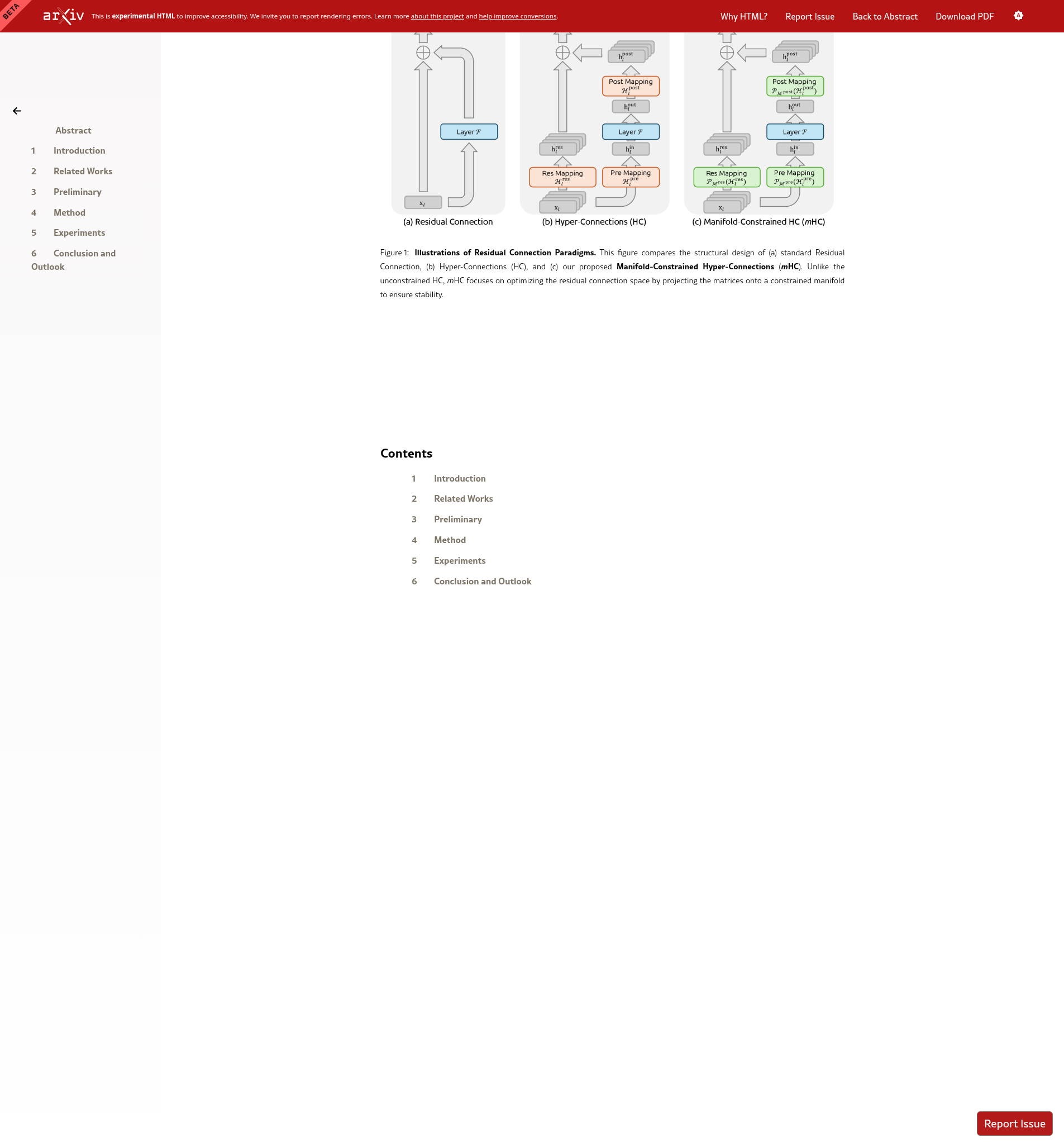
Compare: (a) Standard connection, (b) Hyper-Connections, (c) mHC (from the mHC paper)
The breakthrough idea was shockingly simple: skip connections.
🔄 How Residual Connections Work
Learn F(x)
F(x) + x
This means the network only needs to learn the difference from the input, not the full transformation!
Why This Fixes Everything
With skip connections, gradients can flow directly through the network:
- Identity shortcut: Even if all weights are zero, the network passes information through unchanged: output = 0 + x = x
- Gradient highway: Gradients can skip layers entirely, preventing vanishing
- Easier learning: Network only needs to learn "what's different," not everything
The result? Researchers could now train networks with 152, 1000, even 10,000 layers!
Residual Learning Framework
ResNet reframes the learning objective. Instead of learning a desired mapping H(x), residual blocks learn:
The output becomes:
Mathematical Advantages
- Identity by default: If F(x) = 0, then y = x. Networks can easily represent identity mappings.
- Gradient preservation: The gradient flows through both paths:
∂y/∂x = ∂F/∂x + 1Even if ∂F/∂x → 0, ∂y/∂x ≈ 1, preventing vanishing gradients.
- Ensemble behavior: ResNets implicitly ensemble many shallow paths (Veit et al., 2016).
Impact
ResNet won the ImageNet 2015 competition with 152 layers—8× deeper than previous winners. More importantly, it enabled the modern era of deep learning, with models now routinely having hundreds or thousands of layers.
What You Learned
🎓 Key Takeaways
- Deep networks should be better but weren't due to vanishing gradients
- Vanishing gradients: Gradients shrink to near-zero in early layers
- ResNet solution: Skip connections preserve gradient flow
- Identity mapping: Output = F(x) + x, learning only the difference
- Result: Networks with 100+ layers became trainable!
But here's the thing: ResNet was just the beginning. Researchers kept pushing, trying even more complex connection patterns. Which brings us to the next challenge...
Summary: From Shallow to Deep
- Hierarchical learning: Deep layers should capture abstract features
- Vanishing gradients: Chain rule causes exponential gradient decay
- Degradation problem: Deep networks perform worse, not due to overfitting
- Residual connections: y = F(x) + x enables identity mappings
- Gradient flow: Skip connections provide gradient highways
Next: We explore extensions to residual connections—Hyper-Connections—and the challenges they introduce, leading to the mHC solution.